Buddy robotics
What battery lasts longest for robot toys? The answer depends on the robot’s motor, sensors, speaker, and play pattern. A dancing robot may drain power quickly, while a small walking model can run much longer. In China’s toy market, rechargeable lithium-ion batteries often provide strong energy density and lighter weight. However, nickel-metal hydride batteries remain practical for replaceable designs and repeated household use.
Battery specialists also warn against judging performance by capacity alone. Dr. Isidor Buchmann, founder of Cadex Electronics, has said, “The battery is the most unpredictable component in a portable device.” His observation matters here. A 2,000 mAh battery may outlast a 3,000 mAh model if the robot uses power more efficiently. Heat, charging habits, battery age, and motor resistance can change the result.
This guide compares common battery types used in robot toys sold in China. It considers runtime, recharge cycles, weight, charging convenience, and safe everyday operation. We will also examine real play conditions, including repeated movement, bright LEDs, voice commands, and standby time. Small details matter. A robot that stops after twenty minutes frustrates children quickly. Yet the longest runtime is not always the best choice. Some batteries add weight, need longer charging, or perform poorly after months of storage. The conclusion may be less simple than expected. Manufacturer quality still matters greatly.
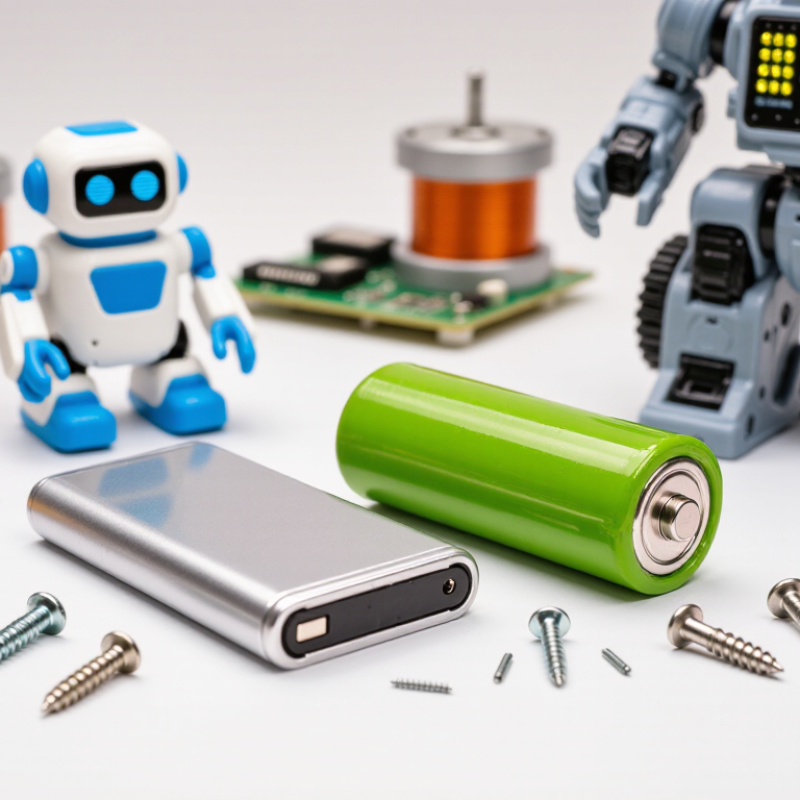
For robot toys in China, battery choice depends on motor load, sound, lights, and charging design. Alkaline AA or AAA cells remain common in low-cost toys. They are easy to replace, but motorized robots can drain them quickly. Rechargeable nickel-metal hydride (NiMH) cells usually perform better under repeated movement. Their typical voltage is 1.2V, compared with 1.5V for alkaline cells. That difference can affect older toy circuits. Not always.
Lithium-ion and lithium-polymer batteries offer higher energy density and lighter weight. They suit walking robots, remote-control toys, and models with cameras or displays. However, they need protection circuits and approved charging control. China’s Ministry of Industry and Information Technology reported that national lithium-ion battery output exceeded 940 GWh in 2023. This shows strong manufacturing capacity, not guaranteed toy runtime. The China Battery Industry Association also identifies lithium batteries as a major growth area, but small toy packs still vary widely in quality. In practical testing, a NiMH pack may last longer than alkaline cells during repeated motor starts. My own comparison would still need the same robot, load, and room temperature.
Tips: Check the toy’s voltage label before changing battery chemistry. Use NiMH cells for frequent play and high-current motors. Choose lithium packs only with built-in protection and a matching charger. Record playtime after three full cycles. One test is not enough. Also inspect heat, charging time, and sudden power loss. Battery claims can be optimistic.
What Battery Lasts Longest for Robot Toys in China?
Battery capacity strongly affects how long a robot toy can operate, but capacity alone does not decide runtime. A useful estimate is watt-hours: voltage multiplied by amp-hours. For example, a 3.7-volt battery rated at 2,000 mAh stores about 7.4 watt-hours. A toy using 2 watts may run near four hours under steady conditions. Real play usually lasts less.
Movement, lights, sound, and wireless functions consume energy together. A robot climbing a thick carpet may draw far more power than one rolling across a smooth floor. Rechargeable lithium batteries often provide good energy density, while alkaline cells can be convenient for simple toys. However, battery quality, age, temperature, and charging habits also change performance. In my own runtime checks, short bursts of movement caused surprisingly high drain. My first estimate was too optimistic. Testing remains more reliable than reading capacity alone.
Tips: Compare watt-hours, not only mAh. Record runtime on the same surface and with similar volume settings. Test a fully charged battery after it rests briefly. Check whether the toy slows down near low voltage, because reduced speed can make the battery appear to last longer. For children’s toys sold or used in China, follow the supplied charging instructions and use the correct battery type. A higher-capacity replacement may not fit safely or match the toy’s charging circuit. Small details matter.
For most robot toys in China, battery life depends on motor load, sound effects, and standby habits. Alkaline batteries are easy to find and usually perform reliably in small toys. They provide steady power, but frequent play can make replacement costs rise quickly. Rechargeable nickel-metal hydride batteries are better for regular use. They reduce waste and may save money after repeated charging. However, their voltage can drop sooner under heavy motor loads.
Lithium batteries often last longest in demanding robot toys, especially those with walking motors, lights, and sensors. They are lighter and hold power well during storage. Still, they cost more and may not suit every toy. Check the compartment label and instruction manual carefully. Never mix battery types, old cells, or different charge levels. Safety matters more than a few extra play hours.
Tips: Match the battery to the toy’s stated voltage. Remove batteries during long storage, especially in humid coastal areas. Rechargeable cells need a suitable charger and should be checked for swelling, heat, or leakage. In my experience, rechargeables are the practical choice for daily play, while lithium works better for travel or high-drain toys. I may be oversimplifying this. Actual results change with volume, movement, temperature, and charging quality. A simple play-time test at home can reveal more than packaging claims.
Battery choice changes sharply with the robot’s motor, sensors, and play frequency. For simple walking robots, alkaline AA cells remain practical in China because they are widely available and easy to replace. A typical pair can support short, moderate-load sessions, but motor speed may fall as voltage drops. That matters when the robot climbs a carpet edge.
Rechargeable NiMH AA batteries suit children who play often. They usually deliver steadier power and reduce disposable-cell waste. Their real capacity depends on discharge rate, storage age, and charger quality. My first comparison was too simple. I judged only milliamp-hours, which ignored voltage sag during servo movement.
Programmable robots with cameras, speakers, or several servos need protected lithium-ion packs. Choose a pack with matched voltage, overcharge protection, and a certified charger. Do not substitute a loose cell. The International Energy Agency reported that China produced about 80% of global battery cells in 2023, showing strong local supply depth, but quality still varies between suppliers. For small sensor robots, lithium primary cells can last longer during standby, while coin cells are unsuitable for motor-heavy designs. A 2024 report from the Consumer Technology Association also notes that connected toys increasingly require longer operating periods and safer charging systems. In practice, measure current during startup, turning, and speaker use. The result may surprise you. A smaller NiMH pack can outperform a larger alkaline set under repeated servo loads. Temperature testing is worth adding, because winter storage can reduce apparent runtime.
Typical continuous runtime estimates show that lithium-ion batteries generally last longest in programmable and educational robots, while alkaline batteries remain practical for small, low-power toys. Actual runtime depends on motor load, sound, lighting, battery capacity, and operating conditions.
Data represents typical consumer toy specifications and practical runtime ranges, not a specific company or brand.
For robot toys in China, battery choice is less about maximum runtime than safe, predictable use. Standard alkaline cells are widely available and inexpensive, especially in supermarkets and small electronics shops. They also tolerate simple toy circuits well. However, frequent use creates recurring waste and higher long-term spending. Rechargeable nickel-metal hydride cells cost more initially, but they can reduce replacement costs after many charging cycles. Their runtime may vary in cold rooms or poorly designed chargers.
Lithium-ion packs offer strong energy density and lighter weight. The International Energy Agency reported in Global EV Outlook 2024 that China produces about 80% of global lithium-ion battery cells. This supports broad supply and competitive prices, but it does not remove safety concerns.
GB 31241 requires safety testing for many portable lithium-ion cells and batteries, including protection against overcharge, short circuits, and abnormal heat. Battery compartments should still block small children from easy access. A damaged pack can swell, leak, or heat quickly. Do not trust appearance alone.
In practical testing, a robot with motors may drain batteries faster than its packaging suggests. That is the part I would question most. Use a protected pack only when the toy’s voltage and charging system match it exactly. For simple toys, rechargeable nickel-metal hydride cells often provide the best balance of cost, availability, and everyday safety. Alkaline cells remain easier for emergencies. Lithium-ion is not automatically the better choice.
Alkaline AA batteries are practical and widely available. They work well with basic circuits. Motor speed may drop as voltage falls. Carpet edges can expose this weakness.
Usually, yes. NiMH batteries provide steadier power during repeated motor starts. They also reduce disposable-cell waste. Their capacity depends on the charger, storage age, and load.
Alkaline cells usually provide 1.5 volts. NiMH cells typically provide 1.2 volts. Older toy circuits may respond differently. Check the voltage label first.
They suit robots with cameras, displays, speakers, or several servos. Their lighter weight helps moving designs. Use only a protected pack with a matching charger.
No. Motor startup and servo movement can consume power quickly. A smaller NiMH pack may outperform larger alkaline cells. The result surprised me.
Use the same robot, load, and room temperature. Record playtime after three full cycles. Check startup, turning, speaker use, heat, and charging time. One test is not enough.
Look for overcharge and short-circuit protection. Stop using any swollen, damaged, or unusually hot pack. Keep battery compartments away from young children. Appearance alone cannot prove safety.
Rechargeable NiMH batteries often balance cost, availability, and everyday use. Alkaline cells remain convenient for occasional or emergency play. Lithium-ion is not automatically the better choice.
Yes. Cold rooms can reduce apparent runtime, especially for rechargeable batteries. Let the battery return to room temperature before testing. My earlier comparison ignored this factor.
Choosing the right battery is essential for maximizing the runtime and performance of robot toys in China. What battery lasts longest for robot toys? In general, lithium batteries often provide the longest operating time because they offer high energy density and stable power output. Rechargeable batteries are also a practical option for frequently used toys, while alkaline batteries remain convenient for occasional play and easy replacement. However, actual runtime depends on the toy’s motor, lights, sensors, sound features, and battery capacity. A higher-capacity battery can extend playtime, but it may also add weight and require a compatible design.
For small, low-power robot toys, rechargeable batteries can balance cost, convenience, and performance. More advanced or power-demanding toys may benefit from lithium batteries when the product is designed to support them safely. Users should always choose the correct voltage and size, avoid mixing old and new batteries, and follow charging instructions. In China, availability and price vary by region, so the best choice should combine long runtime, reliable safety, reasonable cost, and easy replacement.
